[Alex:] All right, let's get started with our backgrounds and questions for "Social Responsibilities and Intellectual Freedom."
Collections
Our first topic on this matter is collections.
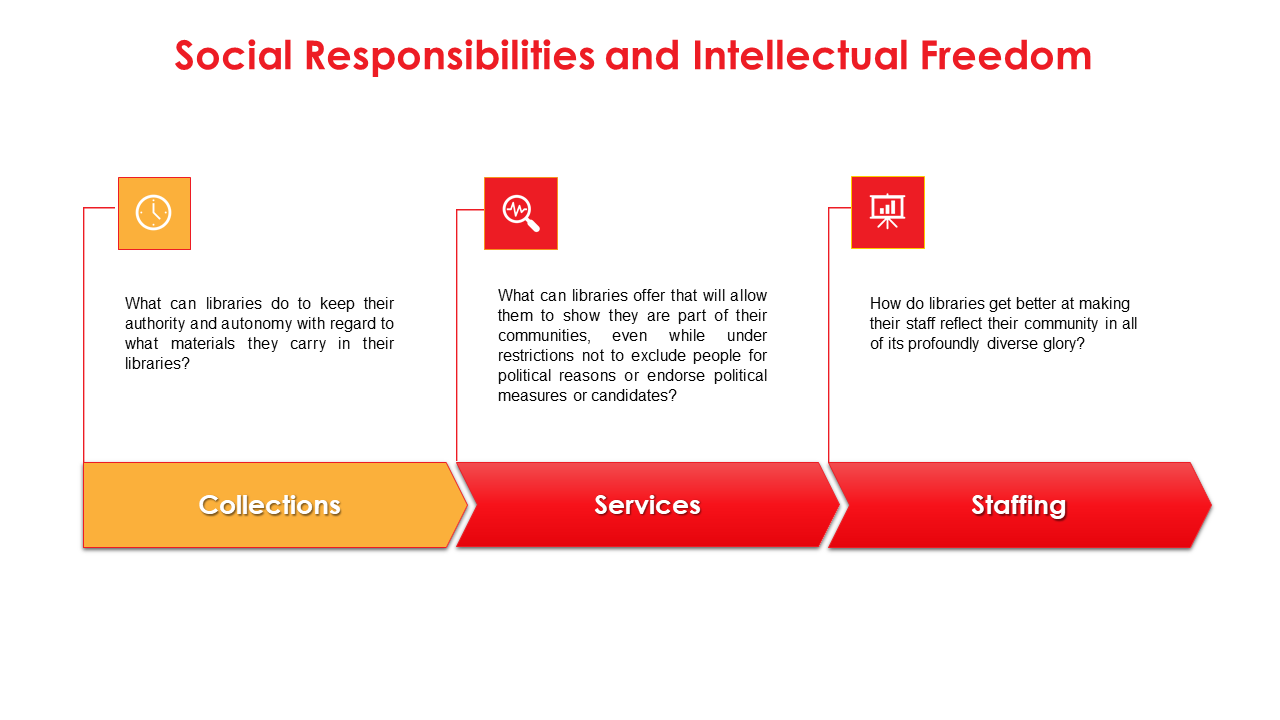
Seeming Contradictions Between ALA Pronouncements
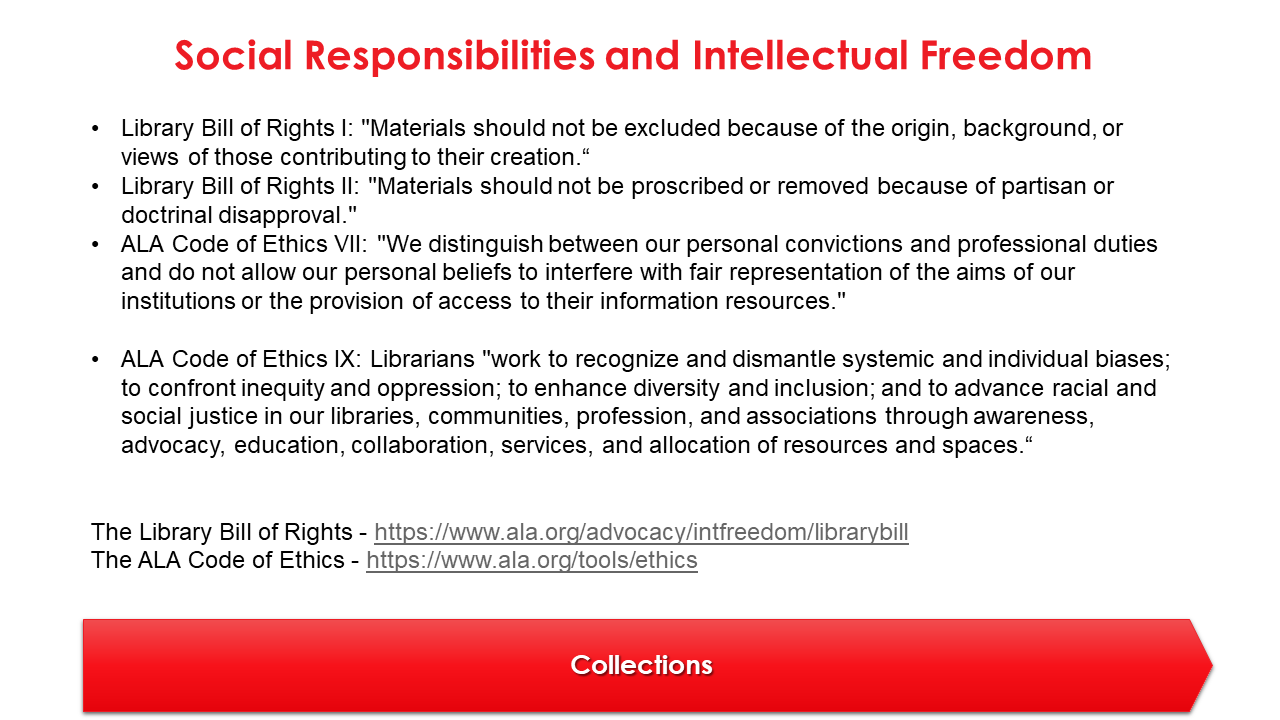
A little background for our viewers. The Library Bill of Rights has several secions in it that are about the inclusion or exclusion of materials based on certain criteria, whether the "origin, background, or views of those contributing to their creation," and that we should not remove materials from the library based on "partisan or doctrinal disapproval." [Library Bill of Rights, I and II]
Recently, as in, this decade, there was also an additional element added to the the ALA's Code of Ethics that says librarians "work to recognize and dismantle systemic and individual biases; to confront inequity and oppression; to enchance diversity and inclusion;"--and boy, is that a topic in these days--"and to advance racial and social justice in our libraries, communities, profession, and associations." [ALA Code of Ethics IX]
So my question for both of you is:
- To achieve the aims of the newest Principle of the Code of Ethics, there may be situations where librarians should, or feel they should, exclude, remove, or not buy materials for reasons that might conflict with the pronunciations in the Library Bill of Rights or the earlier principle of the Code of Ethics. How do librarians navigate this clash of pronouncements, and, if one of these opposing pronouncements has to give way, which one should be subordinated to the other?

[Gavin:] You want to start, Robin?
[Robin:] Sure. So, I don't necessarily find them mutually exclusive. We're not good at nuance, and I don't know if this is a recent thing, or if it's always been this way. I've done collection development since 2001, and I feel like in the past we were much better at nuance, and so, we didn't necessarily not buy things for our own personal reasons, but our own personal reasons sometimes agreed with the idea that we shouldn't buy them.
For example: I remember early in the 2000s, there was a book called Natural Cures, and it had a subtitle after that, and it was by Kevin Trudeau, who ended up going to prison. [The book's title is Natural Cures "They" Don't Want You To Know About.] I was at a different library system, we bought the book. The subject specialist for that area was livid with us because we bought it, and we did kind of think there were so many requests, and then subsequently holds, on the book, and we're talking, like, 600, we felt like we had to buy this thing, even though it was giving out all kinds of mis- and disinformation on health matters.
Where you put that book was a different story. You didn't have to put it in the medical section, you could put it somewhere else. But, eventually, well, eventually, he went to prison, and eventually, we got rid of the book just because it was not what we wanted to have in our collection. Did we disagree with it? Yes. But it was also wrong. So I don't see how that is necessarily getting rid of something for your own personal preference.
Sometimes it is that way, and that is what we really need to work hard to avoid. If I were to say, "I'm going to get rid of this, just because I don't like it," or "I'm not going to buy this, just because I don't like it," that, to me, is then not in accordance with the Library Bill of Rights. But if I happen to not like this thing, that also is patently untrue and shouldn't be in our library, those two things, to me, are compatible. If I were to use a law analogy, and I probably shouldn't, but if I were, it would be something like I remember from my employment law class: I can fire you for any reason, but I can't fire you for a prohibited reason. And that is kind of how I think of these things coexisting.
[Gavin:] I think a big part of it really also comes down to your collection development policy and the role that your particular library plays.For example, I'm a high school librarian, and my role in what the sorts of books I'm selecting are going to be different than the needs for a public library, because one of the things I am intending to do is helping provide--making sure information is accurate for my students. The thing to keep in mind is that, you know, if information is not necessarily accurate, you know, at a high school, I might not want to include it, but if there's a demand for it at the public library, that is a different situation that your collection development policy can help guide yourself forward.
The other thing to keep in mind is: sometimes having that incorrect information is still important to have, so that someone who is studying that will want to know what is out there. For example: when I was in high school, I did a report on, specifically, what the Romani people faced during the Holocaust. As a part of my research, I read "Mein Kampf". This was not a book that should really be in a high school library, but I was able to go to the public library and get a copy and read it. Not because anyone thought it was a good book, but it has that historical importance, and it's very important for people to know what's in it so we know how to combat the misinformation that's in it.
A part of that really does get into the different roles of your library versus my library versus other libraries, and how our collection development policies help direct that.
[Robin:] And your goals, too.
[Gavin:] Yeah.
[Robin:] So, for our public library, we have a goal that we don't have scholarly textbooks. That is where we draw the line. If someone wanted something that was too scholarly, we would say, "Oh," you know, that "this is not part of our collection development plan. This is not something that we collect." And we would direct you, probably, to Interlibrary Loan. So there are lots of different reasons why you wouldn't have something.
I think about--if a kid was doing a project, I remember from my days working reference, we would have kids come in, and we would pull all the books, like, on planets, or whatever, and have them just all on a cart, and people would come in, and if you came in early, you got the good books, and if you didn't come in early, you got what was left.
[Gavin:] Yes.
[Robin:] And, for the kid that comes in late and gets what is left, what is left should be still accurate. It shouldn't be, "Well, we have this book. It's not accurate, we know it's not accurate, and we have it for a different reason," so that--a lot of it depends on, again, I wouldn't put that in the same area as the books that are accurate.
We have books about "People believe the Earth is flat," and then we have books about the Earth, and those two aren't together. A lot of it is where you place things, and, when you're pulling those books, you're not going to pull that one, because you know it's not accurate. You're not going to put it out there as if it is. There's work for us to do as librarians. We can't just rely on "We're gonna put it all out there and see what happens." Nope. This is a profession for a reason.
[Alex:] Fantastic. Thank you both for your insight on this situation. It's nice to see that there are ways that we can manage to make things that, on face, might seem opposed, still compatible with each other.
[Gavin:] Absolutely. Because, also, the thing to keep in mind is sometimes, that incorrect information can be used to help combat the misinformation.